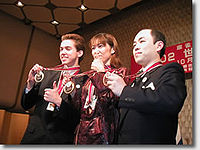
November 23, 2008

  • Stephy Tang 鄧麗欣 喬寶寶

    Equal opportunity is a term which has differing definitions and there is no consensus as to the precise meaning. Some use it as a descriptive term for an approach intended to provide a certain social environment in which people are not excluded from the activities of society, such as education, employment, or health care, on the basis of immutabletraits. Equal opportunity practices include measures taken by organizations to ensure fairness in the employment process. A basic definition of equality is the idea of equal treatment and respect.

    In job advertisements and descriptions, the fact that the employer is an equal opportunity employer is sometimes indicated by the abbreviations EOE or MFDV which stands for Male, Female, Disabled, Veteran.

    Picture Qbobo 1360 

  • P1020052 Thank God,reaching for you!

    ccc 

  • EO2 & 喬寶寶

    aaa

    梁榮忠 Kary & Qbobo

    Picture Qbobo 1368 

    孫耀威 Suen Yiu Wai, Eric & Qbobo

    Picture Qbobo 1366 Picture Qbobo 1365 Picture Qbobo 1360 aaa bbb

    BE EQUAL

    P1020014 P1010976

    P1020051

    xxx

    Picture Qbobo 1361 

    abc

    Kary & Qbobo 

    Be Equal to Male,Female,Veterans & Disable

    Give Opportunity to everyone!

    Hong Kong started ,the World will follow!

November 20, 2008

  • 15th Anniversary!


    http://player.youku.com/player.php/sid/XNTUyOTg4Njg=/v.swf

    landy

    Andy Lau people's choice & Qbobo


    Picture Qbobo 1274

    Alan Tam my Idol & Qbobo

    Picture Qbobo 1273

    Alex Alak & Qbobo

    Picture Qbobo 1278

    The up going actor Lam Ka Tung

    Picture Qbobo 1277

    The most creative  Wilson & Qbobo

    Picture Qbobo 1270

    Beauty & Qbobo

    Picture Qbobo 1271

    Picture Qbobo 1284

    The most dangerous but generous actor of HK Ricky Wong Chun Tong

    Picture Qbobo 1286 Picture Qbobo 1287 Picture Qbobo 1288 Picture Qbobo 1293

    Picture Qbobo 1292

    The Love of Chinese!

    Picture Qbobo 1294

    Old is Gold but new is Diamond!

    Picture Qbobo 1295

    Beautiful Lady Yip Tung

    Picture Qbobo 1296

    Talented skills Yan Chi Tan

    Picture Qbobo 1297

    Most Loved Yam Tat Wah

    Picture Qbobo 1298

    Brother 3 with wife & Qbobo

    Picture Qbobo 1299

    Picture Qbobo 1301

    The Comedian actor of Hk Eric Tsang Chi wai with Brian & Qbobo

    Picture Qbobo 1303 Picture Qbobo 1304 Picture Qbobo 1310 Picture Qbobo 1313

    Picture Qbobo 1306 Picture Qbobo 1307

    Picture Qbobo 1313 Picture Qbobo 1319

    Picture Qbobo 1326 Picture Qbobo 1327 Picture Qbobo 1328 Picture Qbobo 1329

     Picture Qbobo 1336 Picture Qbobo 1337 Picture Qbobo 1345 Picture Qbobo 1347

    xxxxxxxxxxxxxxxxxxxxxxxxxxxxxxx

    FRIENDS

    Picture Qbobo 1355

    Nothing more I can say!

November 12, 2008

  • JAPANESE RESTAURANT

    hISTORY OF sUSHI

    Sushi

    http://www.tudou.com/programs/view/PU_hs8gs7Dw


    Picture Qbobo 1240
    Different types of sushi ready to be eaten.
    Platter of sushi.

    In Japanese cuisine sushi  is vinegared rice usually topped with other ingredients, including fish, various meats, and vegetables. Outside of Japan, sushi is sometimes misunderstood to mean the raw fish itself, or even any fresh raw-seafood dishes. In Japan, sliced raw fish alone is called sashimi and is distinct from sushi, as sashimi is the raw fish component, not the rice component. The word sushi itself comes from an archaic grammatical form of a word that is no longer used in other contexts; literally, "sushi" means "it's sour".

    There are various types of sushi: sushi served rolled inside nori (dried and pressed layer sheets of seaweed or alga) called makizushi (巻き or rolls; sushi made with toppings laid with hand-formed clumps of rice called nigirizushi (にぎり); toppings stuffed into a small pouch of fried tofucalled inarizushi; and toppings served scattered over a bowl of sushi rice called chirashi-zushi (ちらし).


    Picture Qbobo 1239 //

     History

    Main article: History of sushi

    The main idea in the preparation of sushi is the preservation and fermentation of fish with salt and rice, a process that has been traced back to Southeast Asia where fish and rice fermentation dishes still exist today. The science behind the fermentation of fish in rice is that the vinegar produced from the fermenting rice breaks the fish down into amino acids. This results in one of the five basic tastes, called umami in Japanese. The oldest form of sushi in Japan, Narezushi still very closely resembles this process. In Japan, Narezushi evolved into Oshizushi and ultimately Edomae nigirizushi, which is what the world today knows as "sushi".

    Modern Japanese sushi has little resemblance to the traditional lacto-fermented rice dish. Originally, when the fermented fish was taken out of the rice, only the fish was consumed and the fermented rice was discarded. The strong-tasting and -smelling funazushi, a kind of narezushi made near Lake Biwa in Japan, resembles the traditional fermented dish.

    Beginning in the Muromachi period (1336–1573) of Japan, vinegar was added to the mixture for better taste and for preservation. The vinegar accentuated the rice's sourness, and was known to increase its life span, allowing the fermentation process to be shortened and eventually abandoned. In the following centuries, sushi in Osaka evolved into oshi-zushi, the seafood and the rice were pressed using wooden (usually bamboo) molds. By the mid 18th century, this form of sushi had reached Edo (contemporary Tokyo).


    The contemporary version, internationally known as "sushi," was invented by Hanaya Yohei(華屋与兵衛; 1799–1858) at the end of Edo period in Edo. The sushi invented by Hanaya was an early form of fast food that was not fermented (it was therefore prepared quickly) and could be eaten with one's hands roadside or in a theatre.Originally, this sushi was known as Edomae zushi, because it used freshly caught fish in the Edo-mae (Edo Bay or Tokyo Bay). Though the fish used in modern sushi no longer usually comes from Tokyo Bay, it is still formally known as Edomae nigirizushi.

    Types of sushi

    Types of sushi

    The common ingredient across all the different kinds of sushi is sushi rice. The variety in sushi arises from the different fillings and toppings, condiments, and the way these ingredients are put together. The same ingredients may be assembled in a traditional or a contemporary way, creating a very different final result.

    Nigiri-zushi

     Picture Qbobo 1238

     Western Sushi

    The types of sushi rolls typically found in the west are rarely found in Japan and are typically thought of as an invention to suit the American palate, The increasing popularity of sushi in North America, as well as around the world, was fueled by the invention of the California roll and has resulted in numerous regional off-shoots being created. The following is a list of typical ingredients in popular rolls.

    • The California roll consists of avocado, kani kama (imitation crab stick), and cucumber, often made uramaki (with rice on the outside, nori on the inside)
    • The caterpillar roll generally includes avocado, unagi, kani kama, and cucumber.
    • The dynamite roll includes yellowtail (hamachi), and fillings such as bean sprouts, carrots, chili and spicy mayo.
    • The rainbow roll is typically a California roll topped with several various sashimi.
    • The spider roll includes fried soft shell crab and other fillings such as cucumber, avocado, daikon sprouts or lettuce, roe, and spicy mayonnaise.
    • A Philadelphia roll almost always consists of smoked salmon, cream cheese, cucumber, and/or onion.
    • A BC roll has grilled salmon skin with sweet sauce and cucumber. It is named after British Columbia for its famous wild Pacific salmon.
    • A crunchy roll is typically a California roll with shrimp tempura wrapped inside with the other ingredients, with the outside of the roll coated with fried tempura batter crumbs. It is often topped with sweet eel sauce or chili sauce.
    • Other rolls may include scallops, spicy tuna, beef or chicken or teriyaki roll, okra, vegetables, and cheese. Sushi rolls can also be made with Brown rice and black rice. These have also appeared in Japanese cuisine.
    • Picture Qbobo 1237

     Ingredients

    Various nigiri sushi in an ice sculpture.

    All sushi has a base of specially prepared rice, and complemented with other ingredients.

     Sushi rice

    Sushi is made with white, short-grained, Japanese rice mixed with a dressing made of rice vinegar, sugar, salt, and occasionally kombu & sake. It is usually cooled to room temperature before being used for a filling in a sushi. In some fusion cuisine restaurants, short grain brown rice and wild rice are also used.

    Sushi rice (sushi-meshi) is prepared with short-grain Japanese rice, which has a consistency that differs from long-grain strains such as India. The essential quality is its stickiness. Rice that is too sticky has a mushy texture; if not sticky enough, it feels dry. Freshly harvested rice (shinmai) typically has too much water, and requires extra time to drain the rice cooker after washing.

    There are regional variations in sushi rice and, of course, individual chefs have their individual methods. Most of the variations are in the rice vinegar dressing: the Tokyo version of the dressing commonly uses more salt; in Osaka, the dressing has more sugar.

     Nori

    A sheet of nori.

    The seaweed wrappers used in maki and temaki are called nori. Nori is an alga, traditionally cultivated into the harbors of Japan. Originally, algae was scraped from dock pilings, rolled out into thin, edible sheets, and dried in the sun, in a process similar to making rice paper. Whereas in Japan Nori may never be toasted before being used in food, many brands found in the U.S. reach drying temperatures above 108 degrees Fahrenheit.

    Today, the commercial product is farmed, produced, toasted, packaged, and sold in standard-size sheets in about 18 cm by 21 cm (7 in by 8 in). Higher quality nori is thick, smooth, shiny, green, and has no holes. When stored for several months, nori sheets can change color to dark green-brownish.

    Nori by itself is an edible snack and is available with salt or flavored with teriyaki sauce. The flavored variety, however, tends to be of lesser quality and is not suitable for sushi.

    Picture Qbobo 1236  
    • Wasabi
    A piquant paste made from the grated root of the wasabi plant. Real wasabi (hon-wasabi) is Wasabi japonica. Hon-wasabi has anti-microbial properties and may reduce the risk of food poisoning.The traditional grating tool for wasabi is a sharkskin grater or samegawa oroshi.
    An imitation wasabi (seiyo-wasabi), made from horseradish and mustard powder and dyed green is common. It is found at lower-end kaiten zushi restaurants, in bento box sushi and at most restaurants outside of Japan. If it is manufactured in Japan, it may be labelled "Japanese Horseradish".
    In sushi restaurants, wasabi may be referred to as namida ("tears").
    • Gari
    Sweet, pickled ginger. Eaten to both cleanse the palate as well as to aid in the digestive process.
    • Ocha
    In Japan, green tea (ocha) is invariably served together with sushi. Better sushi restaurants often use a distinctive premium tea known as mecha. In sushi vocabulary, green tea is known as agari.Nutritional informatio
    Picture Qbobo 1238
    FATS

    The main ingredients of sushi, raw fish and rice are naturally low in fat (with the exception of some rolls, especially Western style rolls), high in protein, carbohydrates, vitamins, and minerals. Specifically:

    • Fats: Most seafood are naturally low in fat; and what fat is found in them is generally rich in unsaturated fat Omega-3. Since sushi is often served raw, no fat is introduced in its preparation.
    • Proteins: Fish, tofu, seafood, egg, and many other sushi fillings contain high levels of protein.
    • Vitamins and Minerals: These are found in many of the vegetables used for sushi. For example, the gari and nori used to make sushi are both rich in nutrients. Other vegetables wrapped within the sushi also offer various degrees of nutritional value.
    • Carbohydrates: These are found in the rice and the vegetables.

     Health risks

    Some fish such as tuna, especially bluefin, can carry high levels of mercury and can be hazardous when consumed in large quantities. As of January 2008, quite a few New York City restaurants offer tuna sushi with high enough concentration of mercury that a weekly reference dose is contained in 2−6 pieces, depending on the amount of tuna in the sushi and the person's weigHt.

    Consuming raw or undercooked seafood presents the risk of anisakiasis .Uncooked seafood also often carries the bacterium Vibrio parahaemolyticus, which can cause diarrhea. Also, sushi carries the risk of transmitting parasitic infection and other pathogens. In addition, some forms of sushi, notably puffer, can cause severe poisoning if not prepared properly. Sushi is usually eaten with salty condiments such as soy sauce, which are added by the diner in whatever quantity is desired. Those with hypertension or renal disorders must take care not to eat too much salt inadvertently by overusing such condiments.

     Etiquette

    Sushi can be eaten either by hand or using chopsticks, although traditionally nigiri is eaten with the fingers because the rice is packed loosely so as to fall apart in one's mouth, and would disintegrate on chopsticks. Condiments (soy sauce, wasabi, and pickled ginger) are used as desired.

    As one connoisseur counsels, "adding wasabi to soy sauce is a disaster. It reduces the spiciness dramatically and masks the taste of the fish."

    Many sushi restaurants offer fixed-price sets, selected by the chef from the catch of the day. These are often graded as shō-chiku-bai (松竹梅), shō/matsu (松, pine), chiku/take (竹, bamboo) and bai/ume (梅, ume), with matsu the most expensive and ume the cheapest. The house soy sauce is often diluted with dashi, a broth made from fish flakes and kelp.

    In Japan, staff in sushi restaurants often employ a complex code-like vocabulary, where alternate words are substituted for common items. For example, egg is called gyoku ("jewel"), rice is called shari (Buddha's bones), soy sauce is called murasaki ("purple") and the bill is known as o-aiso ("courtesy", "compliment"). The code words vary from place to place and often evolve locally to incorporate puns: for example, shako might be called garēji (garage), because the Japanese word shako can also refer to a vehicle depot. These terms would not be used, or even understood, in other contexts, but regular patrons may pick up and use this specialized terminology themselves while dining in the restaurant.

    Guinness World Records

    1. January 1992: A 325 kg (715 lb) Bluefin tuna sold for $83,500 (almost $257 / kg or $117 / lb) in Tokyo, Japan. The tuna was reduced to 2,400 servings of sushi for wealthy diners at $75 per serving. The gross income, not counting the cost of the fish or the costs of producing the sushi, was $180,000. At the time, the fish held the record for Most Expensive Fish.
    2. October 12, 1997: The longest sushi roll. Six hundred members of the Nikopaka Festa Committee made a kappamaki (cucumber roll) that was 1 km (3,281 ft.) long at Yoshii, Japan.

     Gallery

     See also CURRY!


    ZZZ

    THX FOR WATCHING!

November 11, 2008

  • Mahjong


    Mahjong

    aaaa

    bbbb

    cccc

     Picture Qbobo 1219 


    Picture Qbobo 1184

     
    A game of Mahjong being played in Hangzhou, China
    Mahjong
    Players2–4
    Age range4 years and older
    Setup time2–10 minutes
    Playing time0–3 hours
    Random chanceYes
    Skills requiredTactics, observation, memory

    Mahjong (also called mah-jongg by the American association, is a game for four players that originated in China. Mahjong involves skill, strategy, and calculation, as well as a certain degree of chance. Depending on the variation which is played, luck can be anything from a minor to a dominant factor in success. In Asia, mahjong is also popularly played as a gambling game. In the game, each player is dealt either thirteen or sixteen tiles in a hand (depending on the variation being played). On their turn, players draw a tile and discard one, with the goal of making four or five melds (also depending on the variation) and one pair, or "head". Winning comes "on the draw", by drawing a new or discarded tile that completes the hand. Thus a winning hand actually contains fourteen (or seventeen) tiles.


    Picture Qbobo 1182 //

    History

    Mahjong in China

    One of the myths of the origin of Mahjong suggests that Confucius,the great Chinese philosopher, had developed the game in about 500 BC. This assertion is likely to be apocryphal. According to this myth, the appearance of the game in the various Chinese states coincided with Confucius' travels at the time he was teaching his new doctrines. The three dragon (Cardinal) tiles also agree with the three Cardinal virtues bequeathed by Confucius. Hóng Zhōng ( , lit. middle) the Red, Fā Cái ( , lit. prosperity) the Green, Bái Pi ( , lit. white) the White represent Benevolence, Sincerity, and Filial piety respectively, again under this myth. In fact, the "middle" is likely a reference to 中国 (zhōngguó) — China's name in Chinese.

    Also, this myth claims that Confucius was fond of birds, which would explain the name "Mahjong" (sparrow). However, there is no evidence of Mahjong's existence before the Taiping era in the 19th century, which eliminates Confucius as a likely inventor.

    Many historians believe it was based on a Chinese card game called Mǎdiào (馬吊) (also known as Ma Tiae, lit. Hanging Horse; or Yèzí (葉子), lit. Leaf) in the early Ming dynasty.[2] This game was played with 40 paper cards similar in appearance to the cards used in the game Ya Pei. These 40 cards, numbered 1 to 9 in four different suits along with four extra flower cards, are quite similar to the numbering of Mahjong tiles today. Although Mahjong only has three suits and, in effect, uses four packs of Ya Pei cards.

    There is still a healthy debate about who created the game. One theory is that Chinese army officers serving during the Taiping Rebellion created the game to pass the time. Another theory is that a noble living in the Shanghai area created the game between 1870 and 1875. Others believe that around 1850 in the city of Níngpō two brothers had created Mahjong from the earlier game of Mǎdiào.

    This traditional Chinese game was banned in its homeland in 1949, when the People's Republic of China was founded. The new Communist government forbade any gambling activities, which were regarded as symbols of capitalist corruption. After the Cultural Revolution, the game was revived, and once again Mahjong has become a favorite pastime of the Chinese, as well as in Hong Kong, Macau, Taiwan and elsewhere.

    Picture Qbobo 1176  

    Mahjong in the Western world

    Students in the United States learning how to play Mahjong

    By 1895, Stewart Culin, an American anthropologist, wrote a paper in which Mahjong was mentioned. This is the first known written account of Mahjong in any language other than Chinese. By 1910, there were written accounts in many languages including French and Japanese. In 1920, Abercrombie & Fitch became the first ever American brand to introduce the game.It became a success in New York, and owner of the Company, Ezra Fitch, sent emissaries to Chinese villages to buy every set of Mahjong they could find. Abercrombie & Fitch sold a total of 12,000 sets. Later, an important English book was Joseph Park Babcock's Rules of Mah-Jongg, which, simplified in 1920, was simply known as the "red book". Although this was the earliest version of Mahjong that had been introduced to America, many of Babcock's simplifications were abandoned when the 1920s fad died out.

    The game was a sensation in America when it was imported from China in the 1920s, as the same Mahjong game took on a number of trademarked names, such as Pung Chow or the Game of Thousand Intelligences. Part of Mahjong nights in America was to decorate rooms in Chinese style and dress like Chinese. Several hit songs were also recorded during the mahjong fad, most notably "Since Ma is Playing Mah Jong" by Eddie Cantor.

    American Mahjong, which was mainly played by women during the time, grew from this craze. By the 1930s, many revisions of the rules developed that were substantially different from Babcock's classical version (including some that were considered fundamentals in other variants, such as the notion of a standard hand). Standardization came with the formation of the National Mah Jongg League (NMJL) in 1937, along with the first American mahjong rulebook, Maajh: The American Version of the Ancient Chinese Game.

    While Mahjong was accepted by U.S. players of all ethnic backgrounds during the Babcock era, many consider the modern American version a Jewish game,as many American Mahjong players are of Jewish descent. (Also, the NMJL was founded by Jewish players and considered a Jewish organization.) In addition, players usually use the American game as a family-friendly social activity, not as gambling.

    British author Alan D. Millington revived the Chinese Classical game of the 1920s with his book, The Complete Book of Mah-jongg (1977). This handbook includes a formal rules set for the game. Many players in Western countries consider Millington's work authoritative.

     Picture Qbobo 1188 Picture Qbobo 1190 Picture Qbobo 1192 Picture Qbobo 1194

     Current development

    Today, the popularity and the characteristics of players of Mahjong vary from country to country. There are also many governing bodies, which often host exhibition games and tournaments. It remains far more popular in Asia than in the West.

    In Japan, there is a traditional emphasis on gambling and the typical player is male. Many devotees there believe the game is losing popularity and have taken efforts to revive it. In addition, Japanese video arcades have introduced Mahjong arcade machines that can be connected to others over the Internet.

    Mahjong culture is still deeply ingrained in the Chinese community: Sam Hui wrote Cantopop songs, using Mahjong as their themes. Hong Kong movies have often included scenes of Mahjong games. Gambling movies have been filmed time and again in Hong Kong, and a recent sub-genre is the Mahjong movie.

    A recent study by doctors in Hong Kong concluded that the game can induce epileptic seizures

    Picture Qbobo 1186  

     Type of game

    Due to the solid form of the tiles, Mahjong is sometimes classified as a 'domino game'. This is unrealistic as the tiles are not double-headed like a western domino. Mahjong is more similar to western-style card games such as rummy with the unusual extra characteristic of having a 'hard' card.

      Picture Qbobo 1211 Picture Qbobo 1207 Picture Qbobo 1205 Picture Qbobo 1201

     Variants

    Beijing residents playing Mahjong in public.

    There are many variations of mahjong. In many places, players often observe one version – and are either unaware of other variations or claim that different versions are incorrect. Although many variations today differ only by scoring, there are several main varieties:

    • Chinese Classical Mahjong is the oldest variety of Mahjong, and was the version introduced to America in the 1920s under various names. It has a small, loyal following in the West, although few play it in Asia.
    • Hong Kong Mahjong or Cantonese Mahjong is possibly the most common form of Mahjong, differing in minor scoring details with the Chinese Classical variety.
    • Sichuan Mahjong is a growing variety, particularly in southern China, disallowing eating, and missing the "fa", "zhong", and other pieces. It can be played very quickly.
    • Taiwanese Mahjong is the variety prevalent in Taiwan and involves hands of 16 tiles, as opposed to the 13-tile hands in other versions. It also features bonuses for dealers and recurring dealerships, and allows for multiple players to win from a single discard.
    • Japanese Mahjong is a standardized form of Mahjong in Japan, found prevalently in video games. In addition to scoring changes, the rules of riichi and dora are unique highlights of Japanese Mahjong.
    • Western Classical Mahjong is a descendant of the version of Mahjong introduced by Babcock to America in the 1920s. Today, this term largely refers to the Wright-Patterson rules, used in the U.S. military, and other similar American-made variants that are closer to the Babcock rules.
    • American Mahjong is a form of Mahjong standardized by the National Mah Jongg League and the American Mah-Jongg Association – and makes the greatest divergence from traditional Mahjong. It uses Joker tiles, the Charleston, plus melds of five or more tiles, and eschews the Chow and the notion of a standard hand. Purists claim that this makes American Mahjong a separate game. In addition, the NMJL and AMJA variations, which differ by minor scoring differences, are commonly referred to as Mahjongg or Mah-jongg (with two Gs, often hyphenated).
    • 3-Player (or 3-ka) Mahjong is a simplified 3-person Mahjong which involves hands of 13 tiles, and total tiles of 84 on the table and uses Joker tiles as well. It only includes the tong zhi tiles or circular shapes of patterns on the tiles for which is different from the conventional Chinese mahjong which has bamboo patterns, 10-thousand and the tong zhi tiles. It has jackpot or Royal Flush rules of winning, in which whoever accumulates a point of 10 is considered to hit the jackpot, with that some would double the winning stake. There are advantages of playing this version of game because you need fewer people to start a game and the turnaround time of a game is short, hence it is considered a speedfast game.
    • Singaporean/malaysian Mahjong is a variant similar to Cantonese mahjong played in Malaysia. Unique elements of Singaporean/Malaysian mahjong are the four animal tiles (cat, mouse, cockrel and centipede) as well as certain alternatives in the scoring rules, which allow payouts midway through the game if certain conditions, such as a kang are met.

    Other variants include Fujian Mahjong (with Dàidì Joker 帶弟百搭), Vietnamese Mahjong (with 16 different kinds of joker), and Filipino Mahjong (with the Window Joker). In addition, Pussers Bones is a fast-moving variant developed by sailors in the Royal Australian Navy; it uses a creative alternative vocabulary, such as Eddie, Sammy, Wally, and Normie instead of East, South, West, and North.'

    Picture Qbobo 1203

     Mahjong Competition Rules

    The top three of the World Championship in Mahjong, Tokyo, October 2002. In the middle: world champion Mai Hatsune from Japan.
    The first Open European Mahjong Championship, Nijmegen, the Netherlands, June 2005.
    The winners of the second Open European Mahjong Championship, Copenhagen, Denmark, June 2007. From left, Kohichi Oda (2), Martin Wedel Jacobsen (1), Benjamin Boas (3)
    Picture Qbobo 1213

    In 1998, in the interest of changing mahjong from an illegal gambling game to an approved 'healthy sport', the China State Sports Commission published a new set of rules, now generally referred to as Chinese Official rules or International Tournament rules. The principles of the new, ‘healthy’ mahjong are: no gambling – no drinking – no smoking. In international tournaments, players are often grouped in teams to emphasize that mahjong from now on is considered a sport.

    The new rules are highly pattern-based. The rulebook contains 81 combinations, based on patterns and scoring elements popular in both classic and modern regional Chinese variants. Some table practices of Japan have also been adopted. Points for flower tiles (each flower is worth 1 point) may not be added until the player has scored 8 points. The winner of a game receives the score from the player who discard the winning tile, plus 8 basic points from each player; in the case of zimo (self drawn win), he receives the value of this round plus 8 points from all players.

    The new rules were used in an international tournament first in Tokyo, where in 2002 the first World Championship in Mahjong was organized by the Mahjong Museum, the Japan Mahjong Organizing Committee and the city council of Ningbo, China, the town where it is believed mahjong most likely originated. One hundred players participated, mainly from Japan and China, but also from Europe and the United States. Miss Mai Hatsune from Japan became the first world champion. The following year saw the first annual China Majiang Championship, held in Hainan. The next two annual tournaments were held in Hong Kong and Beijing. Most players were Chinese, but players from other nations attended as well.

    In 2005 the first Open European Mahjong Championship was held in the Netherlands, with 108 players. The competition was won by Masato Chiba from Japan. The second European championship, in Copenhagen, Denmark, 2007, with 136 players, was won by Danish player Martin Wedel Jacobsen. First Online European Mahjong Championship was held on MahjongTime server in 2007 with 64 players and the winner was Juliani Leo from USA and the best European Player was Gerda van Oorschot from Netherlands. The next European Championship will be held in Austria, 2009.

    In 2006, the World Mahjong Organisation (WMO) was founded in Beijing, China, with the cooperation of, amongst others, the Japan Mahjong Organizing Committee (JMOC) and the European Mahjong Association (EMA). This organization held its first World Championship in November 2007 in the Chinese town of Chengdu, which was won by Li Li, a Chinese student of Tsinghua University. There were 144 participants, from all over the world.

    Critics say that the new rules are unlikely to achieve great popularity outside of tournaments. They argue that regional versions are too well-entrenched, while the Mahjong Competition Rules use many unfamiliar patterns. The new mahjong's advocates claim that it meant to be a standard for international events, not to replace existing variations.

     Equipment

    Picture Qbobo 1217


    Main article: Mahjong tiles
    Basic equipment: chips, tiles and dice.

    Mahjong, can be played either with a set of Mahjong tiles, or a set of Mahjong playing cards (sometimes spelled 'kards' to distinguish them from the list of standard hands used in American mahjong); one brand of Mahjong cards calls these Mhing. Playing cards are often used when travelling as it reduces space and is lighter than their tile counterparts, but are of a lower quality in return. In this article, "tile" will be used to denote both playing cards and tiles.

    Many Mahjong sets will also include a set of chips or bone tiles for scoring, as well as indicators denoting the dealer and the Prevailing Wind of the round. Some sets may also include racks to hold tiles or chips (although in many sets the tiles are generally sufficiently thick so that they can stand on their own), with one of them being different to denote the dealer's rack.

    Computer implementations of Mahjong are also available: these allow you to play against computer opponents, or against human opponents on the Internet.

    A set of Mahjong tiles will usually differ from place to place. It usually has at least 136 tiles, most commonly 144, although sets originating from America or Japan will have more. Mahjong tiles are split into these categories: suits, honor and flowers.

    Picture Qbobo 1178

    Suits

    • Stones: named as each tile consists of a number of circles. Each circle is said to represent can (筒, tóng) coins with a square hole in the middle.

    Image:MJt1.pngImage:MJt2.pngImage:MJt3.pngImage:MJt4.pngImage:MJt5.pngImage:MJt6.pngImage:MJt7.pngImage:MJt8.pngImage:MJt9.png

    CCF09182008_00003

    • Bamboos: named as each tile (except the 1 Bamboo) consists of a number of bamboo sticks. Each stick is said to represent a string (索, sǔo) that holds a hundred coins. Note that 1 Bamboo is an exception. It has a bird sitting on a Bamboo. This is a belief that players cannot draw or add bamboo sticks to 1 Bamboo to change the tile to some other Bamboo.

    Image:MJs1.pngImage:MJs2.pngImage:MJs3.pngImage:MJs4.pngImage:MJs5.pngImage:MJs6.pngImage:MJs7.pngImage:MJs8.pngImage:MJs9.png

    CCF09182008_00002

    • Characters: named as each tile represents ten thousand (萬, wàn) coins, or one hundred strings of one hundred coins.

    Image:MJw1.pngImage:MJw2.pngImage:MJw3.pngImage:MJw4.pngImage:MJw5.pngImage:MJw6.pngImage:MJw7.pngImage:MJw8.pngImage:MJw9.png

    CCF09182008_00001

     Honor

    • Wind tiles: East (東, dōng feng), South (南, nán feng), West (西, xī feng), and North (北, běi feng).

    Image:MJf1.pngImage:MJf2.pngImage:MJf3.pngImage:MJf4.png

    CCF09182008_00000

    • Dragon tiles: red, green, and white. The term dragon tile is a western convention introduced by Joseph Park Babcock in his 1920 book introducing Mahjong to America. Originally, these tiles are said to have something to do with the Chinese Imperial Examination. The red tile ("中"榜, zhōngbǎng) means you pass the examination and thus will be appointed a government official. The green tile ("發"財, fācái,literally "Get Rich") means, consequently you will become financially well off. The white tile (白版,báibǎn,literally "White Tile") means that because a person is doing well they should act like a good, incorrupt official. It usually has a blue border to distinguish from replacement tiles and prevent players from secretly adding lines to effect a victory. In the original Chinese Majiong, the piece called "箭" (jiàn), represents archery, the red "中" represents a hit on the target. In ancient Chinese archery, one would put a red "中" to signify that the target was hit. White "白" represents failure, green "發" means that one will release the draw.

    Image:MJd1.pngImage:MJd2.pngImage:MJd3.png

    000033710013

     Flower

    • Flower tiles: The last category and typically optional components to a set of mahjong tiles, these tiles often contain artwork on their tiles. Many people prefer not to use these tiles due to the fact that they make it easier to win and earn bonus points. For example, if you have no flowers in your hand you get 1 bonus point, and 2 points for 2 bonus tiles of your seat (eg: A pair of the symbol 3 flower and you are west wind. You get 2 bonus points for your hand.)
    • 000033650016  

    The 4 tiles below are flower tiles that represent plum, orchid, chrysanthemum, and bamboo, the four noble plants of Confucian reckoning.

    Image:MJh5.pngImage:MJh6.pngImage:MJh7.pngImage:MJh8.png

    The 4 tiles below are seasonal tiles that represent spring, summer, autumn, and winter.

    Image:MJh1.pngImage:MJh2.pngImage:MJh3.pngImage:MJh4.png

    The suits of the tiles are money-based. In ancient China, the copper coins had a square hole in the center. People passed a rope through the holes to tie coins into strings. These strings are usually in groups of 100 coins called diào (弔 or variant 吊) or 1000 coins called guàn (貫). Mahjong's connection to the ancient Chinese currency system is consistent with its alleged derivation from the game named mǎ diào (馬吊).

    In the mahjong suits, the coppers represent the coins; the ropes are actually strings of 100 coins; and the character myriad represents 10,000 coins or 100 strings. When a hand received the maximum allowed winning of a round, it is called mǎn guàn (滿貫, lit. full string of coin.)

    Picture Qbobo 1174

     Setting up the board

    The following sequence is for setting up a standard Hong Kong (or Singapore) game. Casual or beginning players may wish to proceed directly to gameplay. Shuffling the tiles is needed before piling up.

     Game Wind and Prevailing Wind

    To determine the Player Game Wind (門風 or 自風), each player throws three dice (two in some variants) and the player with the highest total is chosen as the dealer or the banker (莊家). The dealer's Wind is now East, the player to the right of the dealer has South wind, the next player to the right has West and the fourth player has North. Game Wind changes after every round, unless the dealer wins. In some variations, the longer the dealer remains as the dealer, the higher the value of each hand.

    The Prevailing Wind (場風) is always set to East when starting. It changes after the Game Wind has rotated around the board, that is, after each player has lost as the dealer.

    A Mahjong set with Winds in play will usually include a separate Prevailing Wind marker (typically a die marked with the Wind characters in a holder) and a pointer that can be oriented towards the dealer to show Player Game Wind. In sets with racks, a rack may be marked differently to denote the dealer.

    These winds are also significant as winds are often associated with a member of a Flower tile group, typically 1 with East, 2 with South, 3 with West, and 4 with North.

    Picture Qbobo 469

     Dealing tiles

    All tiles are placed face down and shuffled. Each player then stacks a row of tiles two tiles high in front of him, the length of the row depending on the number of tiles in use:

    • 136 tiles: 17 stacks for each player
      • Suits of dots, bamboo, characters + Wind + Dragon
    • 144 tiles: 18 stacks for each player
    • 148 tiles: 19 stacks for dealer and player opposite, 18 for rest
    • 152 tiles: 19 stacks for each player

    The dealer throws three dice and sums up the total. Counting counterclockwise so that the dealer is '1', a player's row is chosen. Starting at the right edge, 'sum' tiles are counted and shifted to the right.

    The dealer now takes a block of 4 tiles to the left of the divide.

    The player to the dealer's right takes 4 tiles to the left, and players (counterclockwise) take blocks of 4 tiles (clockwise) until all players have 12 tiles for 13-tile variations and 16 for 16-tile variations. In 13-tile variations, each player then takes one more tile to make a 13-tile hand. In practice, in order to speed up the dealing procedure, the dealer often takes one extra tile during the dealing procedure to start their turn.

    The board is now ready and new tiles will be taken from the wall where the dealing left off, proceeding clockwise. In some special cases discussed later, tiles are taken from the other end of the wall, commonly referred to as the back end of the wall. In some variations, a group of tiles at the back end, known as the dead wall, is reserved for this purpose instead. In such variations, the dead wall may be visually separated from the main wall, but it is not required.

    Unless the dealer has already won (see below), the dealer then discards a tile. The dealing process with tiles is ritualized and complex to prevent cheating. Casual players, or players with Mahjong playing cards, may wish to simply shuffle well and deal out the tiles with fewer ceremonial procedures.


      DC0802-305

     Charleston

    In the American variations, it is required that before each hand begins, a Charleston is enacted. This consists of a procedure where three tiles are passed to the player on one's right, followed by three tiles passed to the player opposite, followed by three tiles passed to the left. If all players are in agreement, a second Charleston is performed, however, any player may decide to stop passing after the first Charleston is complete. The Charleston(s) are followed by an optional pass to the player across of one, two or three tiles. This is a distinctive feature of American-style Mahjong that may have been borrowed from card games.

     Gameplay

    IMG_9676

    Each player is dealt either thirteen tiles for 13-tile variations or sixteen tiles for 16-tile variations. If a player is dealt a hand of tiles that is determined to be a winning hand (known as "heavenly win", 天胡), he or she may declare victory immediately before the game even begins. But this scenario of victory occurs very rarely.

    A turn involves a player drawing a tile from the wall (or draw pile) and then placing it in his or her hand. The player then discards a tile onto the table. This signals the end of his or her turn, prompting the player to the right to make his or her move. As a form of courtesy, each player is encouraged to announce loudly the name of the tile being discarded. Many variations require that discarded tiles be placed in an orderly fashion in front of the player, while some require that these be placed face down.

    During gameplay, the number of tiles maintained by each player should always be the same, ie. thirteen or sixteen. A player must discard a tile after picking up one. Failure to do so rules that player effectively out of winning (since a winning combination could never be built with one extra tile or fewer), but he or she is obliged to continue until someone else wins.

    When three players drop the West tile, the fourth player will usually avoid discarding another West the following turn. This is caused by a superstition that, when all the players discard a West ("西") together, all players will die ("歸西") or be cursed with bad luck (see Tetraphobia). During the West Prevailing Wind Round, players will also avoid throwing in the One Circle during the first move because One Circle sounds like "together" in mandarin.

    Do not addict,just for fun only!

November 8, 2008

  • Newcastle again!

    Love has No boundary

                    No colour

                    No religion

                    No age

    An incredible  love story has come out of China recently and managed to touch the world.
    It  is a story of a man and an older woman who ran off to live and love each other  in peace for over half a century.  
    aaa


    The 70-year-old Chinese man who hand-carved over 6,000 stairs up a mountain for his 80-year-old wife has passed away in the cave which has been the couple's home for the last 50 years.

    Over 50  years ago, Liu Guojiang a 19 year-old boy, fell in love with a 29 year-old widowed  mother named Xu Chaoqin..

    bbb
    In a twist worthy of Shakespeare's Romeo and Juliet, friends and relatives criticized the relationship because of the age difference and the fact that Xu already had children.

    qqqqq
    At that time, it was unacceptable and immoral for a young man  to love an older woman.. To avoid the market gossip and the scorn of their communities, the couple decided to  elope and lived in a cave in Jiangjin County in Southern ChongQing Municipality.

    qqqq
    In the beginning, life was harsh as hey had nothing, no electricity or even food.  They had to eat grass and roots they found in the mountain, and Liu made a  kerosene lamp that they used to light up their lives.  

    Xu felt that she had tied Liu down and repeatedly asked him, 'Are you regretful? Liu always replied, 'As long as we are industrious, life will improve.'

    In the second year  of living in the mountain, Liu began and continued for over 50 years, to  hand-carve the steps so that his wife could get down the mountain  easily.


    Half a century later in 2001, a group of adventurers were  exploring the forest and were surprised to find the elderly couple and the  over 6,000 hand-carved steps.  Liu MingSheng,  one of their seven children said, 'My parents loved each other so much, they  have lived in seclusion for over 50 years and never been apart a single day.  He hand carved more than 6,000 steps over the years for my mother's  convenience, although she doesn't go down the mountain that  much.'

    qqq


    The couple had  lived in peace for over 50 years until last week. Liu, now 72 years, returned  from his daily farm work and collapsed. Xu sat and prayed with her husband as  he passed away in her arms. So in love with Xu, was Liu, that no one was able  to release the grip he had on his wife's hand even after he had passed away.  

    ccc

    'You promised me you'll take care of me, you'll always be with me until the day I died, now you left before me, how am I going to live without you?'

    Xu spent days softly repeating this sentence and touching her husband's black coffin with tears rolling down her cheeks.


    In 2006, their story became one of the top 10 love stories from China , collected by the Chinese Women Weekly. The local government has decided to  preserve the love ladder and the place they lived as a museum, so this love  story can live forever. 
    20070630_c55abaa830784f70d662XFgpKWInNNTt[1]


    I myself consider to be lucky too,although i cannot sing well ,I was stunned when I received so many offer from

    outside HK to other places ,like Europe & America,Chinese community give me more than i never expected in

    my entire life! specially thanks my sister Black Girl to assist me!

    Picture Qbobo 1106

    Picture Qbobo 1082 Picture Qbobo 1083 Picture Qbobo 1084 Picture Qbobo 1085

    Picture Qbobo 1090 Picture Qbobo 1091 Picture Qbobo 1092 Picture Qbobo 1094

    Picture Qbobo 1096

    Picture Qbobo 1097 Picture Qbobo 1098 Picture Qbobo 1099 Picture Qbobo 1100

    Picture Qbobo 1101 Picture Qbobo 1102 Picture Qbobo 1103 Picture Qbobo 1104

    Picture Qbobo 1105

    The Power of LOVE!

November 7, 2008

  • Road to England

    Become Celebrity

    Ethnic Minority,

    Invitation to China Town!

    Living in HONGKONG.

    Origin from India,

    Performing in England,

    Family living in Scotland,

    Brother in Canada,

    Holding a British Passport,

    Mother Tongue is Punjabi,

    Speak fluent Cantonese,

    Grandfather worked in Shanghai,

    But now in heaven!

    Home in Kowloon,

    Working in TVB,

    Money from Worldwide,

    Only for laugh no CRY!

    Qbb

    Picture Qbobo 983

    Poster in Scotland,my GOD!

    Picture Qbobo 1081 Picture Qbobo 1078 Picture Qbobo 1076 Picture Qbobo 1072 Picture Qbobo 1071 Picture Qbobo 1070 Picture Qbobo 1069 Picture Qbobo 1068 Picture Qbobo 1063 Picture Qbobo 1054 Picture Qbobo 1053 Picture Qbobo 1052 Picture Qbobo 1050 Picture Qbobo 1049 Picture Qbobo 1041 Picture Qbobo 1037 Picture Qbobo 1036 Picture Qbobo 1027 Picture Qbobo 1028 Picture Qbobo 1029 Picture Qbobo 1033 Picture Qbobo 1026 Picture Qbobo 1015 Picture Qbobo 989 Picture Qbobo 1000 Picture Qbobo 1001 Picture Qbobo 1008 Picture Qbobo 982 Picture Qbobo 965 Picture Qbobo 955 Picture Qbobo 959 Picture Qbobo 962

    Picture Qbobo 953 Picture Qbobo 952 Picture Qbobo 949 Picture Qbobo 947 Picture Qbobo 940 Picture Qbobo 941 Picture Qbobo 942 Picture Qbobo 943 Picture Qbobo 928 Picture Qbobo 921 Picture Qbobo 907 Picture Qbobo 908 Picture Qbobo 913 Picture Qbobo 915 Picture Qbobo 906 Picture Qbobo 905 Picture Qbobo 890 Picture Qbobo 861 Picture Qbobo 849 Picture Qbobo 850 Picture Qbobo 770

    Picture Qbobo 173

    Bombay Cottage ,glasgow(Scotland)

    the ONLY solution!

November 6, 2008

October 31, 2008

  •   Halloween

    大家樂060908_0224

    Halloween
    Hallowe'en

    HalloweenHallowe'en

     
    Jack-o'-lantern

    Also calledAll Hallows Eve
    All Saints' Eve
    Samhain
    Hallowed End
    Observed byCanada, Ireland, Australia, United Kingdom, Japan, Bahamas, United States, sometimes New Zealand, Sweden, and many Latin American countries, where it is known as Noche de las Brujas (Night of the Witches)[1]
    TypeReligious, cultural (celebrated mostly irrespective of religion)
    SignificanceThere are many sources of Halloween's significance
    DateOctober 31
    Celebrations

    Trick-or-treating, ghost tours, apple bobbing, costume parties, carving jack-o'-lanterns, bonfires, and fireworks (in Ireland)

    4R-01_DSC00155_#061


    Halloween (or Hallowe’en) is an international holiday celebrated on the evening of October 31; today it is often celebrated in the morning and afternoon as well. Halloween activities include trick-or-treating, ghost tours, bonfires, costume parties, visiting haunted attractions, carving jack-o'-lanterns, reading scary stories, and watching horror movies. Irish and Scottish immigrants carried versions of the tradition to North America in the nineteenth century. Other western countries embraced the holiday in the late twentieth century. Halloween is celebrated in several countries of the Western world, most commonly in the United States, Canada, Ireland, Puerto Rico, Japan, Australia, United Kingdom, and at times in parts of New Zealand. In Sweden, the All Saints' official holiday takes place on the first Saturday of November.

    4R-01_DSC00031_#003 4R-01_DSC00085_#040

    4R-01_DSC00063_#024

    Trick-or-treating and guising

    Main article: Trick-or-treating
    Typical Halloween scene in Dublin, Ireland.

    Costumes

    Main article: Halloween costume

    Halloween costumes are traditionally those of monsters such as ghosts, skeletons, witches, and devils. Costumes are also based on themes other than traditional horror, such as those of characters from television shows, movies, and other pop culture icons.

    Costume sales

    BIGresearch conducted a survey for the National Retail Federation in the United States and found that 53.3% of consumers planned to buy a costume for Halloween 2005, spending $38.11 on average (up $10 from the year before). They were also expected to spend $4.96 billion in 2006, up significantly from just $3.3 billion the previous year.[

    DSC00355

    DSC00336 DSC00350

    History

    Halloween has its origins in the ancient Celtic festival known as Samhain (Irish pronunciation: [ˈsˠaunʲ]; from the Old Irish samain).[1] The festival of Samhain is a celebration of the end of the harvest season in Gaelic culture, and is sometimes[2] regarded as the "Celtic New Year."[3] Traditionally, the festival was a time used by the ancient Celtic pagans to take stock of supplies and slaughter livestock for winter stores. The ancient Gaels believed that on October 31, now known as Halloween, the boundary between the alive and the deceased dissolved, and the dead become dangerous for the living by causing problems such as sickness or damaged crops. The festivals would frequently involve bonfires, into which bones of slaughtered livestock were thrown. Costumes and masks were also worn at the festivals in an attempt to mimic the evil spirits or placate them.[4][5]

    DSC00313 4R-01_DSC00038_#009

    DSC00330 DSC00326

    DSC00365 DSC00359

    DSC00322 4R-01_DSC00061_#001

    4R-01_DSC00094_#047 4R-01_DSC00185_#081

    History of name

    The term Halloween is shortened from All Hallows' Even (both "even" and "eve" are abbreviations of "evening," but "Halloween" gets its "n" from "even") as it is the eve of "All Hallows' Day,"[6] which is now also known as All Saints' Day. It was a day of religious festivities in various northern European Pagan traditions,[7] until Popes Gregory III and Gregory IV moved the old Christian feast of All Saints' Day from May 13 (which had itself been the date of a pagan holiday, the Feast of the Lemures) to November 1. In the ninth century, the Church measured the day as starting at sunset, in accordance with the Florentine calendar. Although All Saints' Day is now considered to occur one day after Halloween, the two holidays were, at that time, celebrated on the same day. Liturgically, the Church traditionally celebrated that day as the Vigil of All Saints, and, until 1970, a day of fasting as well. Like other vigils, it was celebrated on the previous day if it fell on a Sunday, although secular celebrations of the holiday remained on the 31st. The Vigil was suppressed in 1955, but was later restored in the post-Vatican II calendar.

    4R_01_CIMG0309_6 IMG_9676

    DSC00424 聖誕快樂

    DSC00440 CIMG5509

    CIMG5512 CIMG2102

    DSC00469 DSC00480

    SNV30103

    Symbols

    The carved pumpkin lit by a candle inside is one of Halloween's most prominent symbols in America and is commonly called a jack-o'-lantern. Originating in Europe, these lanterns were first carved from a turnip or rutabaga. Believing that the head was the most powerful part of the body, containing the spirit and the knowledge, the Celts used the "head" of the vegetable to frighten off any superstitions.[8] The name jack-o'-lantern can be traced back to the Irish legend of Stingy Jack,[9] a greedy, gambling, hard-drinking old farmer. He tricked the devil into climbing a tree and trapped him by carving a cross into the tree trunk. In revenge, the devil placed a curse on Jack, condemning him to forever wander the earth at night with the only light he had: a candle inside of a hollowed turnip. The carving of pumpkins is associated with Halloween in North America,[10] where pumpkins were not only readily available but much larger, making them easier to carve than turnips. Many families that celebrate Halloween carve a pumpkin into a frightening or comical face and place it on their doorstep after dark. In America, the tradition of carving pumpkins is known to have preceded the Great Famine period of Irish immigration. The carved pumpkin was originally associated with harvest time in general in America and did not become specifically associated with Halloween until the mid-to-late 19th century.

    The imagery surrounding Halloween is largely an amalgamation of the Halloween season itself, nearly a century of work from American filmmakers and graphic artists,[11] and a rather commercialized take on the dark and mysterious. Halloween imagery tends to involve death, magic, or mythical monsters. Traditional characters include ghosts, ghouls, witches, owls, crows, vultures, pumpkin-men, black cats, spiders, goblins, zombies, mummies, skeletons, and demons.[12]

    Particularly in America, symbolism is inspired by classic horror films, which contain fictional figures like Frankenstein's monster and The Mummy. Elements of the autumn season, such as pumpkins and scarecrows, are also prevalent. Homes are often decorated with these types of symbols around Halloween.

    Picture Qbobo 173 Picture Qbobo 159 Picture Qbobo 152

    fj CCF08162008_00000

    CCC Qbobo video 009

    Picture Qbobo 469 000033710029

     000033710013 000033700023 000033700007

    000033650024 000033650014 000033690009


    UNICEF

    "'Trick-or-Treat for UNICEF" has become a common sight during Halloween in North America. Started as a local event in a Philadelphia suburb in 1950 and expanded nationally in 1952, the program involves the distribution of small boxes by schools (or in modern times, corporate sponsors like Hallmark, at their licensed stores) to trick-or-treaters, in which they can solicit small-change donations from the houses they visit. It is estimated that children have collected more than $119 million (US) for UNICEF since its inception. In 2006, UNICEF discontinued their Halloween collection boxes in parts of the world, citing safety and administrative concerns.[14]

    Games and other activities

    In this Halloween greeting card from 1904, divination is depicted: the young woman looking into a mirror in a darkened room hopes to catch a glimpse of the face of her future husband.
    DC0802-305

    There are several games traditionally associated with Halloween parties. The most common[citation needed] is dunking or apple bobbing, in which apples float in a tub or a large basin of water; the participants must use their teeth to remove an apple from the basin. A variant of dunking involves kneeling on a chair, holding a fork between the teeth and trying to drop the fork into an apple. Another common game involves hanging up treacle or syrup-coated scones by strings; these must be eaten without using hands while they remain attached to the string, an activity that inevitably leads to a very sticky face.

    Qbobo 423 Picture Qbobo 295

    Some games traditionally played at Halloween are forms of divination. In Puicíní (pronounced "poocheeny"), a game played in Ireland, a blindfolded person is seated in front of a table on which several saucers are placed. The saucers are shuffled, and the seated person then chooses one by touch; the contents of the saucer determine the person's life during the following year. A saucer containing earth means someone known to the player will die during the next year; a saucer containing water foretells emigration; a ring foretells marriage; a set of Rosary beads indicates that the person will take Holy Orders (becoming a nun or a priest). A coin means new wealth, a bean means poverty, and so on. In 19th-century Ireland, young women placed slugs in saucers sprinkled with flour. A traditional Irish and Scottish form of divining one's future spouse is to carve an apple in one long strip, then toss the peel over one's shoulder. The peel is believed to land in the shape of the first letter of the future spouse's name. This custom has survived among Irish and Scottish immigrants in the rural United States.

    Picture Qbobo 240 Picture Qbobo 003

    Picture Qbobo 006 Picture Qbobo 001

    DC0802-154 eee

    Qbobo 387 CCF08162008_00000

    Unmarried women were frequently told that if they sat in a darkened room and gazed into a mirror on Halloween night, the face of their future husband would appear in the mirror. However, if they were destined to die before marriage, a skull would appear. The custom was widespread enough to be commemorated on greeting cards from the late 19th and early 20th centuries. The mirror gaze was one of many forms of love divination around Halloween and other ancient holy days.

    CIMG1586 DSC00516

    bbb 05082008535

    Qbobo012 [1]  R1052275

    The telling of ghost stories and viewing of horror films are common fixtures of Halloween parties. Episodes of TV series and specials with Halloween themes (with the specials usually aimed at children) are commonly aired on or before the holiday, while new horror films, like the popular Saw films, are often released theatrically before the holiday to take advantage of the atmosphere.

    Picture Qbobo 081 Picture Qbobo 079 Picture Qbobo 078 Picture Qbobo 077 Picture Qbobo 065 Picture Qbobo 063 Picture Qbobo 062 Picture Qbobo 054 Picture Qbobo 052 Picture Qbobo 051 Picture Qbobo 038 Picture Qbobo 031 Picture Qbobo 019 Picture Qbobo 018 Picture Qbobo 016 4R-01_DSC00205_#099

    Haunted attractions

    Main article: Haunted attraction

    Haunted attractions are entertainment venues designed to thrill and scare patrons and typically are seasonal Halloween businesses. They include haunted houses, corn mazes, and hayrides that are staffed by actors in horrifying costumes placed to startle and terrify customers.[15]

    Foods

    fs fg
    fd ff

    Because the holiday comes in the wake of the annual apple harvest, candy apples (also known as toffee or taffy apples) are a common Halloween treat made by rolling whole apples in a sticky sugar syrup, sometimes followed by rolling them in nuts. At one time, candy apples were commonly given to children, but the practice rapidly waned in the wake of widespread rumors that some individuals were embedding items like pins and razor blades in the apples.[16] While there is evidence of such incidents,[17] they are quite rare and have never resulted in serious injury. Nonetheless, many parents assumed that such heinous practices were rampant. At the peak of the hysteria, some hospitals offered free x-rays of children's Halloween hauls in order to find evidence of tampering. Virtually all of the few known candy poisoning incidents involved parents who poisoned their own children's candy, and there have been occasional reports of children putting needles in their own (and other children's) candy in a bid for attention.

    000033750026aaa Qbobo 357

    One custom that persists in modern-day Ireland is the baking (or more often nowadays, the purchase) of a barmbrack (Irish "báirín breac"), which is a light fruitcake into which a plain ring, a coin, and other charms are placed before baking. It is said that those who get a ring will find their true love in the ensuing year. See also king cake.

    大家樂060908_0181

    Around the world Happy Halloween from:

    Q bobo

October 25, 2008

  • U.K. show time

    busy for the outside jobs !

    sorry for the late up-date!

    4R-01_DSC00029_#002 4R-01_DSC00230_#115

    喬寶寶 in the United Kingdom with Black girl

    媽媽,不用擔心!Don't Worry, Ma!」之「父母如何面對子女患有腎結石?」

    4R-01_DSC00102_#053  4R-01_DSC00101_#052

    4R-01_DSC00203_#098 4R-01_DSC00224_#111

    DSC00331 4R-01_DSC00175_#076

    DSC00272 DSC00276

    4R-01_DSC00156_#062-1 4R-01_DSC00198_#093

    4R-01_DSC00209_#103 4R-01_DSC00065_#026

    4R-01_DSC00092_#045 4R-01_DSC00206_#100

    4R-01_DSC00104_#055 DSC00335

    DSC00292 DSC00357


    4R-01_DSC00271_#148

    My U.K.show coming soon !

Categories